
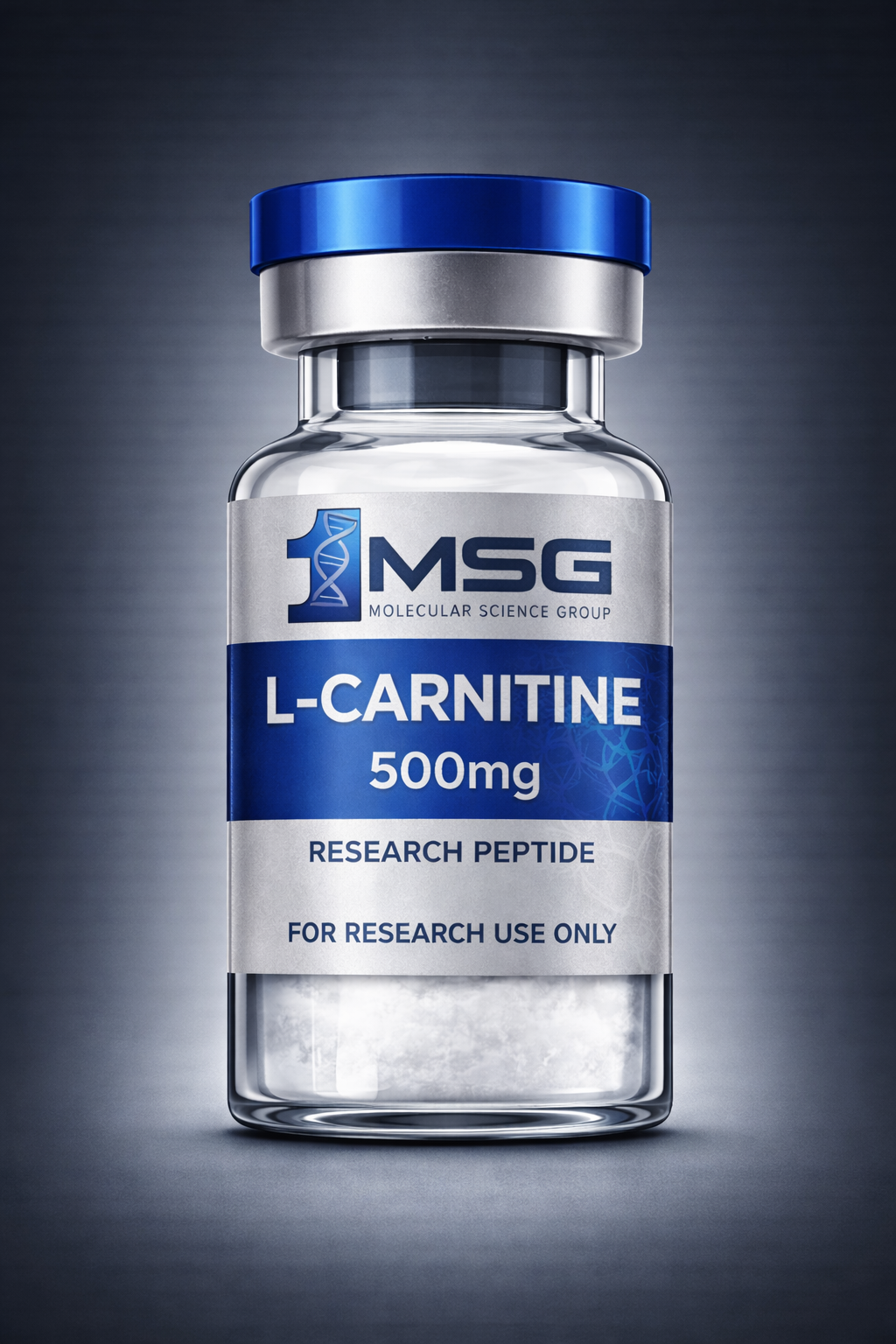
Description
What is L-Carnitine?
L-Carnitine is a naturally occurring amino acid-like compound involved in how the body handles energy. In plain English, it helps shuttle certain fats into the mitochondria, which are often called the cell’s “power plants.” Once there, those fats can be used in energy production pathways.
Because of this central role in mitochondrial function, L-Carnitine has become a widely recognized compound in discussions around energy metabolism, exercise output, recovery, and body composition research. It is commonly compared to other metabolic support ingredients, but stands out because its role in fatty acid transport is so well known.
Researchers are interested in L-Carnitine for several reasons, including how it may influence energy utilization, exercise tolerance, metabolic flexibility, and markers connected to physical performance. It has also gained attention in broader conversations around healthy aging, mitochondrial efficiency, and nutrient-based performance support.
How L-Carnitine Works
The simplest way to understand L-Carnitine is this: it helps the body move long-chain fatty acids into the mitochondria so they can be used for energy. That makes it especially relevant in tissues with high energy demands, such as muscle.
- Supports fatty acid transport: Helps carry certain fats into mitochondria for oxidation.
- Connects to mitochondrial energy production: Often discussed in relation to ATP generation and cellular energy efficiency.
- Relevant to metabolic flexibility: Being studied for how the body shifts between fuel sources like fats and carbohydrates.
- Commonly linked to exercise physiology: Researchers often examine it in relation to endurance, output, and post-exercise recovery interest.
This is one reason L-Carnitine remains popular in both sports nutrition conversations and broader metabolic research settings.
Why L-Carnitine Is Getting Attention
L-Carnitine has been around for a long time, but interest in it continues because mitochondrial health and energy metabolism remain major areas of study. People browsing this category are often looking for compounds that are not just trendy, but also biologically relevant. L-Carnitine fits that description well.
It is often discussed for:
- Exercise and endurance interest
- Recovery and muscle energy demands
- Body composition and fat metabolism discussions
- Healthy aging and mitochondrial support interest
- General metabolic efficiency and energy utilization
It has also gained attention because it is commonly compared to compounds used in performance, metabolic, and mitochondrial support stacks. For many customers, L-Carnitine is appealing because its purpose is easy to understand: it is directly tied to how the body handles fuel.
Potential Benefits Being Studied
While outcomes can vary depending on context, L-Carnitine has shown interest in studies related to several areas:
- Energy metabolism: Being studied for its role in helping cells use fatty acids more efficiently.
- Exercise performance: Often discussed for endurance, output, and physical workload tolerance.
- Recovery support interest: Researchers have explored its relationship to post-exercise recovery markers and muscle stress.
- Body composition research: Commonly included in discussions around fat metabolism and energy expenditure.
- Metabolic health attention: Sometimes examined in relation to glucose regulation, metabolic flexibility, and nutrient utilization.
- Mitochondrial function: Has gained attention for its relevance to tissues with high energy demand.
These are some of the main reasons customers continue to seek out L-Carnitine when exploring mitochondrial and metabolic support compounds.
What Makes L-Carnitine Stand Out
Many ingredients are marketed for “energy,” but L-Carnitine stands out because its role is more specific than a general stimulant effect. It is not simply discussed as a temporary boost. Instead, it is valued for its connection to fuel transport and mitochondrial function.
- Well-known metabolic role rather than vague energy marketing
- Strong relevance to mitochondria and cellular fuel use
- Frequently discussed in performance and recovery settings
- Often compared to other metabolic support compounds because of its foundational role
- Appealing to customers interested in body composition and exercise physiology
For shoppers browsing the catalog, that means L-Carnitine is often seen as a practical, research-relevant option for those interested in how the body produces and manages energy at the cellular level.
Who Is Commonly Interested in L-Carnitine?
L-Carnitine is commonly explored by customers interested in:
- Mitochondrial support compounds
- Exercise performance and endurance research
- Recovery-focused wellness routines
- Body composition and fat metabolism discussions
- Metabolic health and energy utilization interest
- Foundational ingredients with broad research visibility
Because it sits at the intersection of fat metabolism, mitochondrial function, and physical energy demand, L-Carnitine remains one of the most recognized compounds in this category.
Important Notes
L-Carnitine is being studied across a wide range of applications, but it should be viewed as a research and wellness interest compound rather than a guaranteed solution. Discussions around performance, metabolism, recovery, or body composition should always be understood in the context of overall diet, training, physiology, and study design.
If you are looking for a mitochondrial support ingredient with strong name recognition and a clear connection to cellular energy pathways, L-Carnitine continues to be one of the most widely discussed options.
Reviews
There are no reviews yet.